Military Domains and Military Training Areas
In the Czech Republic
Military domains, as special territories earmarked for military training, were established by Act No. 169/1949 on Military Domains.
In 1991, the original number of eight military domains was downsized to current five domains.
In 1999, Act No. 222/1999 on providing defense of the Czech Republic, came in force, which has contained specific clauses on military domains and earmarks their boundary. According to the Act the overall property of the military domain territory – except for the property furnished-in - is the state property. Areas and other immovable property necessary for providing and conducting the military training are under management of appropriate organizational element of the Ministry of Defense meeting Act No. 219/2000 on the property of the Czech Republic. Other areas, primarily used as protection and security zones necessary for training in life fires, are under administration of the Military Forests and Farms of the Czech Republic Corporation.
There is an emphasis given to proportional exploitation of military domains by both military involvement and farming activities under observing environmental protection requirements.
The Military Training Area (MTA) is established on the territory of the military domain as independent organizational entity designed for military use of the military domain. Since December 1, 2003, the military activities in the military domains are managed by Centers of Training Facilities Personnel.
Special training installations are built up on the territories of military domains that include fire ranges for life combat fires and various kinds of specialized training grounds enabling not only the use of up-to-date equipment and armaments with life ammunition but also conducting combined tactical exercises and exercises with combat fires under various terrain and climate conditions and in areas that, under their terrain configurations, are close to supposed and possible areas of military deployment.
The Military Training Areas in remaining five Military Domains gain increasingly in importance since there has been an ongoing trend as of 1991 to concentrate the majority of military training into safe training areas. Therefore only till 2000 there were six tank fire ranges cancelled together with 49 small arms fire ranges dismantled comprising an area up to 480 square kilometers that were close to former and present military garrisons. The process has been speeded up following implementation of the Military Reform aimed at downsizing personnel and equipment.
The Armed Forces of the Czech Republic at present use the following five Military Domains for the military training: Hradiste, Libava, Boletice, Brdy and Brezina. area is designed for a specialized form of training comprising anything with the exception of ground-to-air and air-to-air life fires.
The above mentioned five Military Training Areas are used for coordination exercises prior to operational deployment, joint training of Czech and allied units for testing achieved interoperability and standardization levels, and dependent on free capacities together with implementation of bilateral accords there are several national allied exercises a year conducted in MTA following hire agreements with appropriate national counterparts.
MTA Boletice
| Founded: | May 19, 1947 |
| Area: | 220 square kilometers (54,362 acres) |
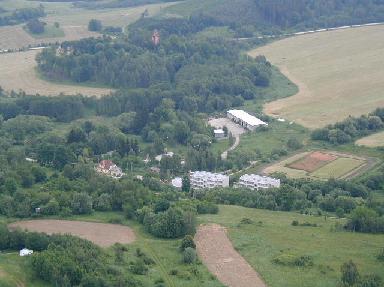
Training installations:
Small arms fire range, life hand-grenade throwing, battle trail, tank and armored personnel vehicle fire ranges, water training facility, anti-tank fire range, driving tracks for any type of combat, engineering training ground, training ground for UN peacekeepers and Armed Forces of the Czech Republic contingents to be deployed abroad, facility for training battle for populated settlement, facility for training of special defensive units.
Billeting and messing facilities: dormitories and log-houses.
Environment
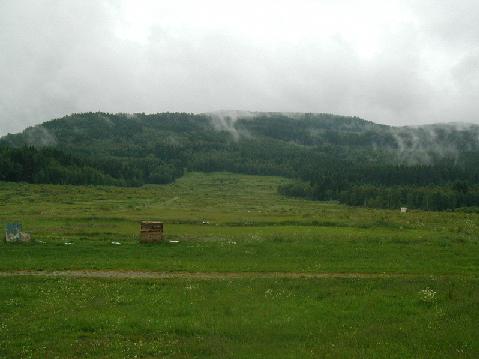
For the most part, the territory is covered with coniferous forests. Almost 50% of the area (11239 ha on the west) has been included in the protected landscape zone, which spreads beyond reach of the main training facilities. The MTA Boletice is home of hundreds of protected species of plants and tens of protected species from animal kingdom.
The most interesting examples of its rich protected flora are German iris, Turk’s-cap lily and arnica. In addition to the protected birds (kingfisher, wood grouse, etc.), the reservation is also the home of Eurasian otters and northern lynxes. Furthermore, pearl oysters, salamanders and crayfish inhabit local ponds or creeks, and 51 land snails can be found here.
A part of the Boletice Miltary Training Area has been incorporated into the Natura 2000 European Project (System), and thus is subject to specific regulations. The project deals with protection of rare birds and ornithologists claim that soldiers enabled them to survive in Boletice, since tanks and fighting vehicles have left trails in the terrain, in which animals can find the needed wetlands.
Region Natural and Cultural Attractions
Šumava Protected Landscape Area
Blanský les Protected Landscape Area (Kleť – tower outlook, observatory)
Lipno Dam (the greatest water reservoir of the Czech Republic)
Český Krumlov (national cultural property, castle and chateau, urban historical reservation – listed by UNESCO)
Boletice:
- Church of St. Nicholas (national cultural monument)
- Razimberk castle ruin
- Residuals of Slavonic settlement - Halštatsko-Latene Cairns
- St. Martin Church
- Celtic Cairns (11 cairns)
Boletice
The first written record on Boletice (Bolotitz) can be found in the King Přemysl Otakar II charter from 1263, through which he granted this village to the Zlatá Koruna monastery. At this time, a Romanesque chapel (today St. Nicholas church) from the second half of the 12th century (masonry, nave, tower) already stood in the village which was re-built in the late gothic style at the end of 15 century (presbytery, sacristy). In 1400, pope Boniface IX joined the Boletice rectory to Zlatá Koruna and entitled it to administer the local church with its seculars and regulars. During the Hussite wars, Boletice was joined to Český Krumlov and since then all property changes were connected with it.
The Razimberk castle ruins can be found near the church (moat with dike and traces of masonry). Near the village (Boletice-Weiherbuhel) the remains of a Slavonic settlement – Halštat Latene Cairns were also discovered.
Polná na Šumava
In Polná na Šumava, in the middle of the village, there is St. Martin church with a cemetery, which originally comes from the 13th century and a presbytery, nave and tower are also from this century. The north porch of the chapel, used as sacristy, was erected in 1488 when the church was re-built in the Late Gothic style. In 1653, during the tower reconstruction, the church was re-built in the Renaissance style. At the present time, the church is restored and it is used for worships of the troops that are exercising in the training area.
In addition, 11 Celtic Cairns the remains of a Celtic settlement can be found here.
Blanský forest and Kleť
The Blanský forest landmark is the granulite rock and wooded hill known as Kleť, which is 1084 m high. A very interesting feature of Kleť is that it is strongly exposed to inversion; when it is minus 24 oC in Český Krumlov, then on Kleť hill it is plus 7 oC. In the summer season, the opposite inversion effect can be felt, even if the differences are not so great.
In 1822, a round stone outlook was built on Kleť, the first of this type in Bohemia in the pseudo-gothic style and approximately 35 m high. In the fifties of the 20th century, TV retranslation station tower about 120 m tall and in 1978 a new TV transmitter was built on the hill. In 1961, a cableway and observatory were built on Kleť hill.
| The remaining Military Domains in the Czech Republic and their area: | |
| Hradiste | 331 square kilometers (81,790 acres) |
| Libava | 327 square kilometers (80,801 acres) |
| Brdy | 260 square kilometers (64,246 acres) |
| Brezina | 158 square kilometers (39,042 acres) |
Coodination Exercises of the Czech Military with NATO and PfP
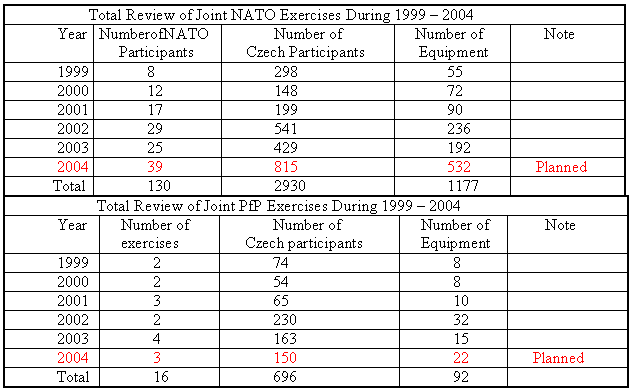
The most important NATO exercise held in 2004 in the Czech Republic
at the Military Training Area Boletice is the
COLLECTIVE EFFORT 2004 (CE04)
Exercise qualification: It is a field interoperability logistic standardization exercise with participation of nine NATO countries under the command of Commander, Joint HQ Centre, Heidelberg, Germany. The exercise will be held in June 11 – 18, 2004 at the MTA Boletice and its training facilities. The goal of the exercise is to verify, evaluate, and demonstrate the logistic systems interoperability level, procedures, equipment and material used by NATO member countries.
The most important PfP exercise to be held this year in the CZECH REPUBLIC
is named BOUNDARY 2004. scheduled to November 8 – 12, to MTA Libava
Exercise qualification: Command Post Exercise with part-time troops deployment solving the scenario in the aftermath of the terrorist attack which resulted in huge fires connected with release of toxic agents as a consequence of large technological disaster of chemical works.