Joint Headquarters Centre Heidelberg, Germany
JHQ-CENT Mission Statement
Joint Headquarters Centre (JHQ Centre) is a multinational NATO Headquarters with an established strength of about 250 military and civilian personnel from thirteen nations and a Headquarters Support Group with an additional 280 military and civilian personnel.
There are three pillars to Joint Command Centre's (JCC) mission, which include:
- collective defense.
- peace support operations.
- the preservation of peace and the promotion of stability.
The essential task of this multinational Headquarters is the operational command and training of NATO forces for a full-scale collective defence mission, a peace support operation or other contingency.
Joint Command Centre contributes to the security and territorial integrity of the Allied Forces Northern Europe area of operations with forces allocated for that purpose. It is prepared to conduct operations and to support or reinforce inter-intra-regionally.
Joint Command Centre preserves peace and promotes stability through co-operation and dialogue, participation in crisis management and by being prepared to plan. and execute, or provide support for, expanded roles and missions as assigned by the Commander-in Chief, Allied Forces Europe Northern Europe.
The Joint Headquarters Centre Crest
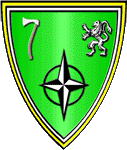
The Joint Headquarters Centre Crest encompasses a combination of various historic roots of the NATO forces stationed in Heidelberg, Germany, since 1952. It combines the Rheindahlen axe, the vigilant lion and the NATO symbol on a green crest - all components from the former Northern Army Group and the Central Army Group crests.
The Franks, who occupied the area of the lower Rhine between 450 and 525 AD, . used the Rheindahlen axe as a weapon in battle. The Rheindahlen axe joins a vigilant lion in an upright striking posture to symbolise strength and courage. The vigilant lion also appears on many crests representing towns and organisations in the Heidelberg region of Germany.
NATO's symbol, adopted by the Alliance in 1953, is comprised of a compass rose (the star-like marking common to a traditional compass). The compass rose suggests the common road to peace taken by Member Nations of the Alliance. The circle within the compass rose symbolises unity and co-operation.
The green background reflects the traditional military colour of land forces and the shield is symbolic of NATO's traditional collective defence mission.
Transition to CC-Land HQ, Heidelberg
The new streamlined command arrangements currently being adopted by the NATO Command Structure will be leaner, more flexible, more efficient and better able to conduct future military operations. They will provide robust capabilities to plan and execute operations, promote the further modernization and interoperability of Alliance forces and enhance the transatlantic link.
In the new command structure, at the strategic level the Allied Command for Operations will conduct all Alliance operations; the Allied Command for Transformation will guide and encourage the transformation of forces and other capabilities. The second operational level will consist of two standing Joint Force Commands. At the third component level, Army, Air Force and Navy Commands and Combined Air Operations Centres will conduct operations and provide service-specific expertise to the second level.
JHQ Centre will be activated as the Component Command-Land Headquarters . (CC-Land HQ), Heidelberg by July 2004 and we have a clear and realistic view of the challenges in implementing this role within the new NATO command structure. Our robust Peace Establishment, manned by experienced and capable staff, will provide the expertise to conduct continuous operations without further initial augmentation. We will maintain higher levels of readiness through a challenging training and exercise programme. This will include the ability to deploy echelons of the HQ rapidly in accordance with the requisite new criteria.
In the broadened military environment facing the Allied Command for Operations, we will be prepared to fulfill a wide variety of potential missions - as well as additionally providing the focus for all land matters. All this will take place within the multinational environment of the forces which may be assigned to us to command. We also expect an increase to the 13 nations presently represented in the HQ. We also intend to retain a minimum level of air, naval and marine staff - as jointness is an integral aspect of all military operations and tasks.
Taken together, these factors will ensure that we are a thoroughly professional, operationally effective and militarily relevant HQ.
Land Integration
As NATO enlarges, both in alliance members and scope of responsibility, JHQ Centre serves a pivotal role in assisting the new alliance members' quest to parallel their military with other NATO nations and help build a stronger alliance. JHQ Centre is charged to lead all land integration actions in the Northern Region, thus supporting nations as they transform their military and develop NATO interoperable policies and procedures. This multi-layered effort focuses on both the Land Force Command Headquarters and tactical level land force elements in order to support NATO's joint military roles.
Initial activities began in 1998 with NATO invitations offered to Poland, Czech Republic and Hungary. With oversight of Poland and Czech Republic Land Integration programs, JHQ Centre set forth a purposeful and sequential process to train and prepare their forces to achieve the NATO interoperability goals. These cooperative efforts culminated in November 2002, with the successful affirmation of 2nd Polish Corps and 1st Czech Mechanized Division in Exercise CANNON CLOUD. Here, the force headquarters displayed their ability to operate at the tactical and operational level both in offensive and defensive operations within a demanding High-Intensity War fighting scenario. Even now, efforts continue with ongoing training and advice provided in bi-lateral actions to the respective Land Forces Command Headquarters. As a consequence of the recent accession of a further seven nations to NATO, JHQ Centre is also responsible for the integration of the land forces of Estonia, Latvia, Lithuania and Slovakia.
Integration proves to be a cooperative endeavour, with at least 13 NATO and National Headquarters fully involved. Multi-layered efforts are coordinated through the Land Integration Working Group, chaired by JHQ Centre's Assistant . Chief of Staff, 3/5/9/Engineer, and under oversight of the Deputy Commander. This single forum synergises support activities provided by an array of sources (including national corps, Bi- or Multi-Lateral agencies, and NATO HQs) into the most effective program for the nations to meet overall NATO Land Integration objectives.